 Skip to content
Packing Mixed Candy by Weight, Ratio, or Piece Count: Which System Do You Need?
Mixed candy can describe several different production requirements. One plant may need an accurate 2 lb bag with a reasonably even assortment. Another may need four candies in a fixed weight ratio, while a third requires an exact number of pieces from each flavor. Those jobs do not use the same feeding and weighing logic. Before Smart Weigh discusses machine models, we first determine what must be true about every finished bag.
Before We Talk About Equipment, Define What Must Be in Every Bag
The term mixed candy is not a complete package specification. The production team needs to define exactly what the label, retail contract, or internal quality standard requires.
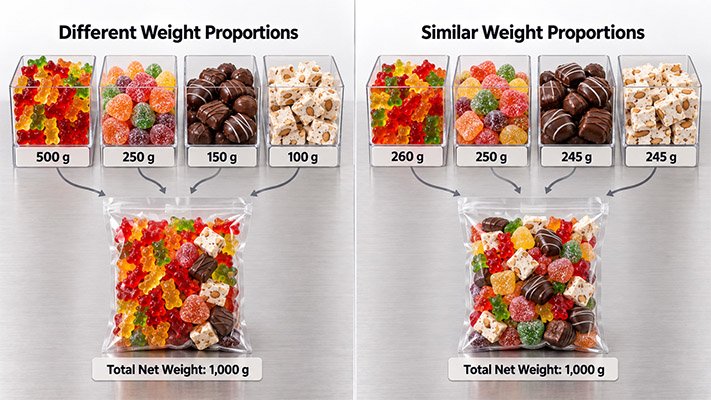
- Does the bag only need to meet a target total net weight?
- Must every candy type appear in every bag?
- Does each candy need a specified weight or percentage?
- Does the package need an exact number of pieces?
- Is the mix requirement checked in every bag or averaged across an entire production run?
- What variation is acceptable for each component?
Weight ratio and piece ratio also need to be separated. If one candy weighs twice as much as another, a 25 percent share by weight will not produce a 25 percent share by piece count. A specification such as equal mix is therefore not precise enough for machine design.
Most projects fall into three groups: total-weight control, individual ratio control, or exact piece counting. Some combine more than one method.
When Only the Final Bag Weight Needs to Be Controlled
The simplest arrangement works when the product can be treated as one combined mix. The different candies are fed upstream, blended into a shared product stream, and delivered to one multihead weigher. The weigher then controls the total weight of the mix before discharging it into the bagger.
A typical line may include separate vibratory feeders, a common incline conveyor, one multihead weigher, a support platform, and a vertical form fill seal machine. This configuration uses fewer weighing sections and simpler controls than a ratio-controlled system.
Smart Weigh used this approach for a project packing four candy types into 2 lb bags. Four vibratory feeders supplied the candies to one large-angle conveyor. A 5 L 14-head weigher controlled the combined 907 g target weight, and a 620 VFFS machine produced bags about 11.8 in wide. The line ran at approximately 30 bags per minute with total-weight accuracy of about ±0.07 oz, or ±2 g. The full configuration is shown in the 2 lb mixed-candy packaging case.
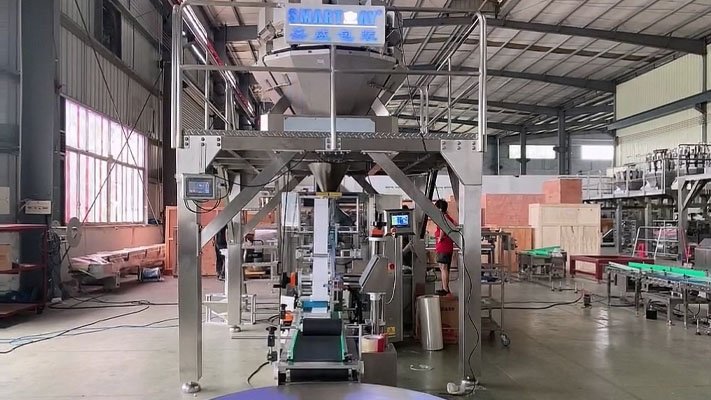
This system fits general assortments, family-size bags, and bulk retail packages where natural variation is acceptable. It does not verify the weight, percentage, or count of an individual candy because the weigher sees one combined product.
Feeder output and product segregation still need testing. If one feeder bridges or changes output after refilling, the blend can shift. Differences in candy size, density, and surface friction can also change the mix as it travels up the conveyor.
When Each Candy Must Follow a Set Recipe
A different design is required when every bag must contain a controlled amount of each candy. For example, a 16 oz package may call for 40 percent Candy A, 30 percent Candy B, 20 percent Candy C, and 10 percent Candy D. In that case, premixing everything before one weigher cannot verify the recipe.
Each candy needs its own feeding and weighing control. Depending on the number of products, accuracy, and speed, the line may use a partitioned mixing weigher or several independent weighing units. The portions are combined only after each component reaches its target.
This provides better recipe control but adds feeders, weighing channels, discharge paths, platform space, and cleaning work. Changeovers take longer because every product path must be cleared and verified.
The component tolerance must be stated before configuration. About 25 percent of each candy is not the same requirement as 4 oz of each candy within a defined tolerance. Those limits should become part of the factory acceptance test.
Speed is normally set by the hardest component to feed and weigh. Adding weighing heads can provide more combinations, but it cannot correct unstable product flow.
When the Bag Calls for an Exact Piece Count
Counting is a separate requirement from weighing. A multihead weigher can sometimes estimate a piece count when every piece has a very consistent weight, but it cannot guarantee an exact count if individual pieces vary.
If one wrapped candy ranges from 0.35 to 0.42 oz, two bags can have the same total weight but different piece counts. A package promising five pieces of each flavor needs actual separation and counting.
Counting systems are commonly used for wrapped candy, lollipops, sample packs, and premium assortments. Each candy type travels through its own feeding and counting channel before the portions are combined. A checkweigher can provide a secondary check for missing or extra pieces.
Reliable separation is the main challenge. Wrapped candy can overlap, flexible wrappers can create static, and lollipop sticks can tangle. Orientation also matters when pieces must enter a tray or carton. Actual product testing is necessary before confirming speed.
Some Bags Need More Than One Control Method
A package may require two pieces of each premium candy and then use a lower-cost candy to reach the final net weight. A hybrid system can count or weigh the required components first, combine them in a common chute, and add a top-up portion. A final checkweigher verifies the complete package. This adds complexity but meets specifications that one standard weigher or counter cannot handle alone.
Product Behavior Can Change the Entire Layout
The product always gets a vote. Two projects with the same recipe and bag size may need different equipment because the candies behave differently in motion.
Useful test information includes piece dimensions, weight range, bulk density, coating, stickiness, fragility, and temperature. Sugar-coated gummies can leave buildup. Oil-coated gummies may flow differently as room temperature changes. Freeze-dried candy can break under a drop that would not damage hard candy, while wrapped pieces can catch on one another.
Hopper volume also matters. A 2 lb portion of hard candy occupies less space than 2 lb of large gummies. If one hopper cannot hold the portion, multiple discharges may reduce bagging speed.
Samples should run through the complete product path. Conveying, distribution, weighing, discharge, and the final drop into the bag can all change the result.
More Control Affects Speed, Cost, and Changeover
| Finished-Bag Requirement | Typical Method | What the System Confirms | Main Tradeoff |
|---|---|---|---|
| Accurate total net weight | Premixing plus one multihead weigher | Combined bag weight | No individual component verification |
| Fixed weight or percentage per candy | Independent feeding and weighing | Weight of each component | More equipment, space, and cleaning |
| Exact pieces per candy | Independent counting channels | Piece count of each component | Product separation can limit speed |
| Count, ratio, and final weight | Hybrid counting and weighing | Multiple package conditions | Highest control complexity |
There is no engineering benefit in paying for independent dosing channels when the contract only calls for a reasonably mixed 2 lb bag. On the other hand, a low-cost premixing line will not solve a fixed-recipe problem. The correct investment is the least complicated system that can repeatedly meet the written package specification.
Prove the Result During the Factory Acceptance Test
The factory acceptance test should use the actual candies and production film whenever possible. The acceptance criteria should be agreed on before machine production, not after the line is assembled.
For a total-weight system, record the average, minimum, and maximum over an agreed sample size and note every package outside tolerance. For a ratio-controlled system, separate and weigh each component. For a counting system, verify every candy type.
The test should include a sustained run. A short peak-speed demonstration does not show what happens as feeders empty, refill, or restart. Check the first packages after a stop because their distribution may differ from steady-state production.
Also inspect breakage, wrapper damage, candy trapped in the seal, incomplete discharge, and product left after a recipe change. A good average weight is not enough; the line must meet the complete specification at the agreed running speed.
What We Need to Size the Line Correctly
Before Smart Weigh recommends a configuration, the project team should provide:
- Photos and samples of every candy
- Minimum and maximum piece dimensions
- Average piece weight and expected variation
- Target amount of each candy by weight, percentage, or count
- Allowed component variation in each bag
- Total bag weight and net-weight tolerance
- Bag style, width, length, and film structure
- Required sustained bags per minute
- Available floor space and ceiling height
- Cleaning, allergen, and product-change requirements
- Plant power and compressed-air conditions
These details allow the three system types to be compared on the same basis.
Use the Simplest System That Meets the Specification
For an accurate total weight and general assortment, premixing followed by one multihead weigher is often the better investment. A defined weight or percentage requires independent component weighing, while a fixed number of pieces requires actual counting.
Start with a clear finished-bag specification. Send Smart Weigh the target weight, required amount of each candy, and whether it is defined by weight or count. We can then narrow down the candy packaging system without adding controls the project does not need.
Contact Smart Weigh USA to review your mixed-candy packaging requirements and arrange product testing.
