 Skip to content
How to Automate Case Packing After a VFFS Packaging Machine
A VFFS packaging machine may automatically form, fill, and seal bags, but that does not mean the packaging line is fully automated. In many factories, operators still collect finished bags, check them, arrange them inside cases, and seal each case manually.
As VFFS output increases, manual case packing becomes a bottleneck. Bags begin accumulating at the discharge, operators struggle to maintain the correct packing pattern, and the VFFS machine may need to slow down while the downstream team catches up.
To automate case packing after a VFFS machine, the line normally needs a bag takeaway conveyor, a checkweigher and metal detector with an integrated automatic reject system, bag spacing or orientation control, an automatic case erector, a suitable case packing system, and a case sealer. The case packer should be selected according to the filled bag’s shape, output, case pattern, and loading orientation.
Why Is Case Packing After a VFFS Machine More Difficult Than It Looks?
A finished VFFS bag is not as predictable as a rigid carton.
When a bag drops onto the takeaway conveyor, it may turn, flip, or overlap the previous bag. Products such as nuts, frozen vegetables, candy, and snacks can also move inside the package, changing its thickness, center of gravity, and surface shape.
Other factors make automatic handling more difficult:
- Residual air changes the filled bag’s dimensions
- Nitrogen-filled snack bags cannot tolerate excessive compression
- Powder, oil, frost, or condensation can reduce vacuum grip stability
- Recently formed seals may still be warm when the bag leaves the VFFS machine
- Uneven discharge intervals can produce temporary surges
- Flexible film can wrinkle at the intended gripping point
These problems become more noticeable at higher speeds. A case packer may be rated for the required bag output, but it will still miss picks or create poor case patterns if bags reach it in an uncontrolled condition.
Automating case packing is therefore not simply a matter of placing a robot after the VFFS machine. The bags must first be inspected and presented in a repeatable position, orientation, and spacing.
Choose the Right Case Packing Method for Your VFFS Bags
Not every VFFS application requires a Delta robot. The best method depends on the package, output, case arrangement, number of SKUs, and required flexibility.
| Case Packing Method | Best Suited For | Main Advantage | Main Limitation |
|---|---|---|---|
| Gravity or Drop Packing | Stable bags with simple case patterns | Simple structure and relatively low cost | Limited control over bag orientation |
| Mechanical Collation and Loading | Consistent bags with fixed, high-volume patterns | Efficient and repeatable | Less flexible for frequent SKU changes |
| Delta Robot Case Packing | Small or medium flexible bags at higher speeds | Fast vision-guided picking and flexible patterns | Requires controlled bag presentation |
| 6-Axis Robot Case Packing | Larger or heavier bags | Higher payload and greater movement range | Usually slower for small, lightweight bags |
Lay-Flat Case Packing
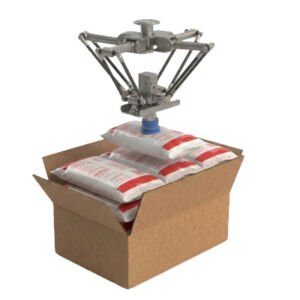
Lay-flat packing is commonly used for pillow bags containing snacks, nuts, candy, frozen food, and similar products. Bags can be arranged in rows and multiple layers, sometimes with alternating directions to make better use of the case.
This method usually provides a stable shipping case, but the package thickness and trapped air must be considered. An unrealistic case pattern may compress the product or place too much pressure on the seals.
Vertical Case Packing
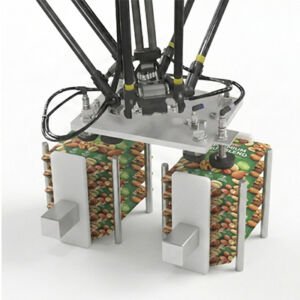
Gusset bags, block-bottom bags, and some retail-ready packages may need to stand vertically inside the case. This arrangement can make the packages easier to display after the case is opened.
However, bags leaving a VFFS machine are rarely standing in the required orientation. A turning, flipping, standing, or pre-collation unit may be needed before loading.
Random Picking or Pre-Collated Loading
A vision-guided robot can locate and pick individual bags that arrive with some variation in position. This offers flexibility but increases the number of robot cycles.
Pre-collated loading groups a fixed number of bags into a row or layer before loading them together. It can reduce robot cycles and produce a more consistent pattern, provided the bags can be grouped reliably.
The final decision should be based on actual filled packages and the required case pattern—not just the initial price of the case packer.
Control and Inspect Bags Before Case Packing
The equipment between the VFFS machine and case packer often determines whether the complete system runs smoothly.
Protect the Bag and Its Seals
The takeaway conveyor should receive the bag without an excessive drop. It must also prevent pressure from being applied to a cross seal that has not fully cooled.
Depending on the product and bag style, this section may include:
- Bag flattening or shaping
- Controlled air removal
- A cooling conveyor
- Height adjustment between machines
- Gentle transfer for fragile products
- Turning or incline conveyors for layout changes
A poor transfer can damage otherwise acceptable bags before they reach inspection or case packing.
Inspect and Reject Defective Bags Before Case Packing
Quality checks should normally take place before secondary packaging. A combined checkweigher and metal detector can verify package weight, detect metal contamination, and automatically reject nonconforming bags before they enter the case packing area.
The automatic reject system is integrated into the checkweigher and metal detector rather than installed as a separate machine. Depending on the project, additional inspection equipment can be added for seal inspection, date-code verification, or double-bag detection.
Rejecting a defective package at this stage prevents it from being placed inside a finished case. Otherwise, operators may need to reopen, inspect, and repack the entire case.
Establish the Correct Spacing and Orientation
Depending on the loading method, bags may pass through centering guides, spacing conveyors, lane dividers, turning units, servo grouping belts, or row-collation equipment.
Vision can identify each bag’s position, but vision alone cannot correct every presentation problem. If bags consistently overlap or pile up, the conveyor arrangement must separate them before they enter the robot’s picking area.
Provide Controlled Accumulation
A short accumulation section allows the VFFS machine to continue producing while a filled case exits and an empty case moves into position. It can also absorb brief interruptions while tape, labels, or corrugated blanks are replenished.
Accumulation must not create excessive back pressure. Soft bags, inflated snack packs, and fragile products may rotate, overlap, or become damaged when pushed together.
Match the Case Packer to the Real VFFS Output
Case packing capacity should be calculated from sustained VFFS output, not a short demonstration speed.
Suppose a VFFS machine produces 80 bags per minute and each case contains ten bags. The downstream system must complete eight cases per minute. However, this simple figure does not account for:
- Full-case removal
- Empty-case positioning
- Bag inspection and rejection
- Multiple loading layers
- Bag orientation
- Case change time
- Temporary VFFS output surges
The case pattern also affects robot capacity. Picking two or three bags together can reduce robot cycles, but only when the bags can be grouped consistently and the end-of-arm tooling can hold them securely.
For a robotic system, the supplier should evaluate the number of packs per pick, travel distance, bags per row, layers per case, and time available for each case change. One robot may be sufficient for a moderate-speed line, while higher output may require multiple robots or pre-collated loading.
The configuration becomes more complicated when multiple VFFS machines feed one centralized case packing area. The system may need to identify different SKUs, route bags to the correct case, and balance output between loading stations.
The goal is to let the case packer absorb normal speed fluctuations without allowing bags to back up at the VFFS discharge.
Build a Coordinated VFFS-to-Case Packaging Flow
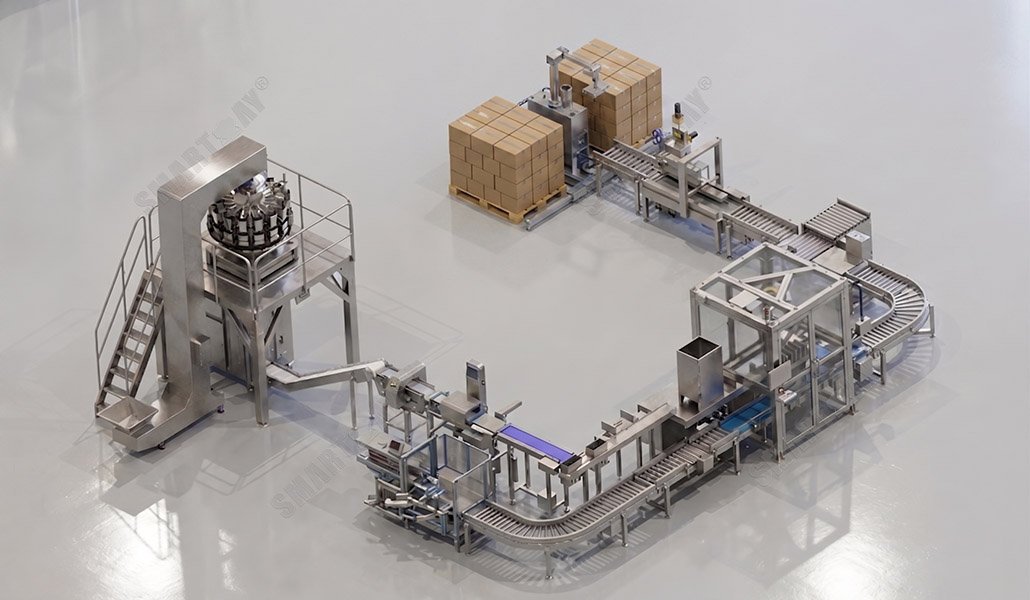
A complete system can include:
- Multihead weigher or filling system
- VFFS packaging machine
- Bag takeaway conveyor
- Checkweigher and metal detector with an integrated automatic reject system
- Bag spacing, turning, or collation equipment
- Automatic case erector
- Mechanical or robotic case packer
- Full-case verification
- Case sealing and labeling
- Optional robotic palletizing
Each machine depends on the equipment before and after it. The case erector must supply empty cases before the loading station is ready. The case sealer must handle the case packer’s sustained output. A full-case checkweigher can detect a missing bag before the case enters storage.
Communication between machines is equally important. The control system should exchange information such as:
- Machine-ready status
- Case-present signals
- Product recipes
- Low-case or low-tape alarms
- Downstream blockage warnings
- Reject confirmation
- Controlled stop and restart commands
If the case packing area stops, the system should first use available accumulation and then send a slowdown or stop signal to the VFFS machine. When the fault is cleared, the equipment should restart in the correct sequence rather than releasing accumulated bags all at once.
How to Retrofit Case Packing to an Existing VFFS Line
Most existing VFFS machines can be connected to automatic case packing equipment, but the project requires more information than bags per minute.
Before designing the retrofit, provide:
- Filled bag samples
- Product type and bag weight
- Bag style and film structure
- Minimum and maximum filled dimensions
- Normal and maximum output
- VFFS discharge height and direction
- Bags per case and required arrangement
- Case dimensions and corrugated quality
- Existing inspection equipment
- Available floor space
- PLC and communication protocol
- Cleaning or washdown requirements
- Future bag and case sizes
The layout should preserve access to the VFFS machine. Conveyors and safety fencing must not interfere with film-roll replacement, cleaning, maintenance, or operator movement.
Other practical questions include where operators will replenish flat cases, whether finished cases move toward the warehouse, whether a manual bypass is required, and whether there is space to add another VFFS machine later.
Testing should use actual filled bags and production cases. A factory acceptance test should verify continuous operation, bag positioning, pick reliability, case patterns, changeovers, full-case counts, seal protection, and recovery from missing cases, blocked bags, or failed picks.
[Image: Existing VFFS line upgraded with inspection, case erecting, robotic loading, and case sealing]Automate the Transition, Not Just the Loading Motion
An automatic case packer cannot compensate for overlapping bags, unstable orientation, insufficient empty-case supply, or poor communication between machines.
Smart Weigh can integrate the complete process, including weighing, VFFS packaging, bag inspection and automatic rejection, orientation, case erecting, robotic or mechanical loading, case sealing, and palletizing. This allows the case packing equipment to be designed around the real behavior and output of the primary packaging line.
Send us your filled bag samples, VFFS output, case dimensions, required packing pattern, and factory layout. We can evaluate a case packing system for your current production and future capacity requirements.
FAQs
Can an Automatic Case Packer Connect to Any VFFS Machine?
Most VFFS machines can be integrated, but the supplier must confirm discharge height, bag direction, output, control signals, available space, and the condition of the finished bags.
What Is the Best Case Packer for Pillow Bags?
It depends on bag stability, speed, case orientation, and SKU range. Stable bags with fixed patterns may use mechanical collation, while faster or more variable applications may benefit from robotic case packing.
Can Nitrogen-Filled Bags Be Packed Automatically?
Yes. The system needs gentle conveying, controlled accumulation, suitable gripping tools, and a tested case pattern that does not excessively compress the bags.
Does the Line Need an Automatic Case Erector and Sealer?
For continuous automatic operation, usually yes. If operators still erect or seal every case manually, those tasks may limit the output of the case packer.
Can One Case Packer Handle Different Bag and Case Sizes?
Yes, within a confirmed range. Recipes can change robot movements and packing patterns, while guide rails or gripping tools may require adjustment or replacement.
