 Skip to content
How to Choose the Right Gummy Packaging Machine for Pouches and Pillow Bags
Gummies look simple on the shelf. Bright colors, clean bags, consistent weight, nice seals, good retail presentation.
But anyone who has packed gummies at production scale knows the real story: gummies can be sticky, soft, oily, sugar-coated, waxed, sanded, fragile, or prone to clumping. That makes them very different from dry candy, nuts, chips, or hardware parts.
Choosing the right gummy packaging machine is not just about buying a bagger. It is about building a line that can feed, weigh, fill, seal, code, inspect, and discharge gummies without creating product waste, bad seals, weight giveaways, or constant operator headaches.
If you are comparing gummy packaging equipment for pouches, pillow bags, or stand-up bags, this guide will help you understand what really matters before you invest.
Why Gummies Are Not Always Easy to Package
A gummy packaging line has to deal with several product behaviors at the same time.
The first issue is stickiness. Gummies may stick to conveyors, hoppers, weigh buckets, discharge chutes, or each other. If the product does not flow smoothly, your machine speed drops and your weighing accuracy becomes unstable.
The second issue is clumping. Some gummies bridge inside the feeding system or form clusters before reaching the weigher. When that happens, the multihead weigher may receive uneven product distribution, which leads to slower combination calculation and inconsistent filling.
The third issue is weighing accuracy. Gummies are often sold in small to medium retail packs, so every extra gram adds up fast. Giveaway may look small on one bag, but across thousands of bags per shift, it becomes real money.
The fourth issue is sealing quality. Gummies with sugar, oil, or coating can contaminate the seal area if the filling process is not controlled. A dirty seal can cause leaks, weak seals, poor shelf appearance, or rejected bags.
The fifth issue is product damage. Some gummies are soft or shaped products, such as gummy bears, rings, worms, fruit shapes, vitamin gummies, or functional gummies. A rough discharge system can deform the product or make the finished bag look messy.
That is why a good gummy packaging solution starts with the product, not the machine catalog.
Start With Your Bag Style
Before choosing the machine model, you need to define your package format. For gummies, the most common bag styles are pillow bags, stand-up pouches, zipper pouches, gusset bags, and sometimes small sachets or stick packs depending on the product and market.
Pillow Bags
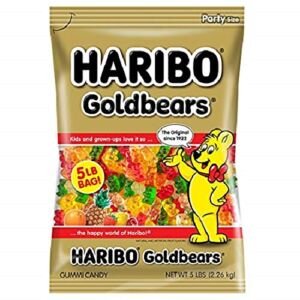
Pillow bags are usually made on a vertical form fill seal machine, also called a VFFS machine. Film is formed into a bag, sealed, filled, and cut automatically.
This format is common for high-volume gummy candy, snack-size packs, promotional packs, and cost-sensitive retail packaging. It is usually a good fit when you need higher speed and lower packaging material cost.
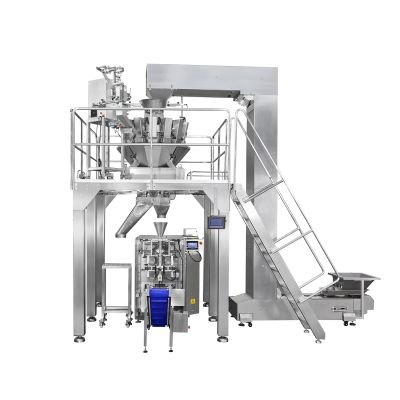
A VFFS gummy packaging line normally includes:
- Incline conveyor or bucket elevator
- Multihead weigher
- Support platform
- Vertical form fill seal machine
- Date coder
- Finished product conveyor
- Optional checkweigher and metal detector
For many gummy manufacturers, this is the most practical setup when the goal is output, efficiency, and consistent bag weight.
Stand-Up Pouches and Zipper Pouches
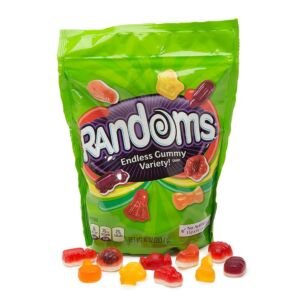
Stand-up pouches are often packed by a premade pouch packing machine. The machine picks up the finished pouch, opens it, fills it, seals it, and discharges it.
This format is popular for premium gummies, supplement gummies, functional gummies, private label products, and retail packs that need better shelf presence.
Premade pouch packaging is usually slower than VFFS, but the final package can look more premium. It also supports zipper pouches, flat bottom pouches, doypacks, and other retail-friendly formats.
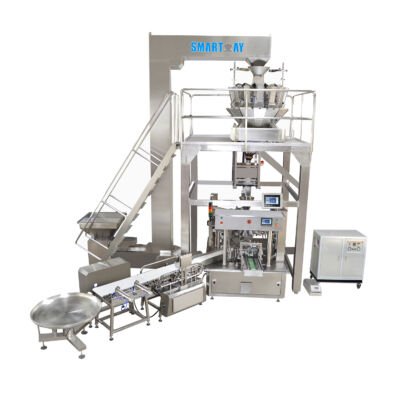
A typical gummy pouch packing line may include:
- Product feeding conveyor
- Anti-stick multihead weigher
- Rotary premade pouch packing machine
- Date coding system
- Checkweigher
- Metal detector
- Finished pouch conveyor
If your brand positioning depends heavily on shelf appeal, stand-up pouches may be worth the higher packaging cost.
Small Packs and Sachets
For very small gummy packs, such as sample packs, kids’ packs, or single-serve packs, the machine selection depends on target weight, gummy size, and required speed.
Some small packs can run on VFFS machines with narrow bag widths. But if the gummies are large, sticky, or inconsistent in shape, the feeding and weighing design becomes even more important.
In short, do not choose the bagger first. Choose the package format first, then design the weighing and feeding system around the gummy.
VFFS vs Premade Pouch Machine: Which One Fits Gummies Better?
There is no one-size-fits-all answer. The right choice depends on your production goal.
A VFFS machine is usually the better fit when you want higher speed, lower packaging cost, and efficient production of pillow bags. It is commonly used for candy factories producing large daily volumes.
A premade pouch machine is usually better when the package appearance matters more, especially for stand-up zipper pouches. It gives you a retail-ready pouch with stronger branding value, but the machine speed is usually lower than a comparable VFFS line.
Here is a simple way to compare them:
| Packaging Format | Best For | Main Advantage | Main Consideration |
|---|---|---|---|
| VFFS pillow bag | High-volume gummy candy | Faster speed and lower film cost | Bag style is simpler |
| Premade stand-up pouch | Premium retail gummies | Better shelf presentation | Higher pouch cost and lower speed |
| Zipper pouch | Reclosable gummy packs | Consumer convenience | Requires stable pouch opening and sealing |
| Small pillow bag | Sample or snack-size packs | Efficient for small weights | Needs careful filling control |
For many gummy manufacturers, the best long-term plan is not choosing only one format forever. It is choosing a supplier who can help you scale from one packaging style to another as your product line grows.
The Multihead Weigher Is the Heart of a Gummy Packaging Line
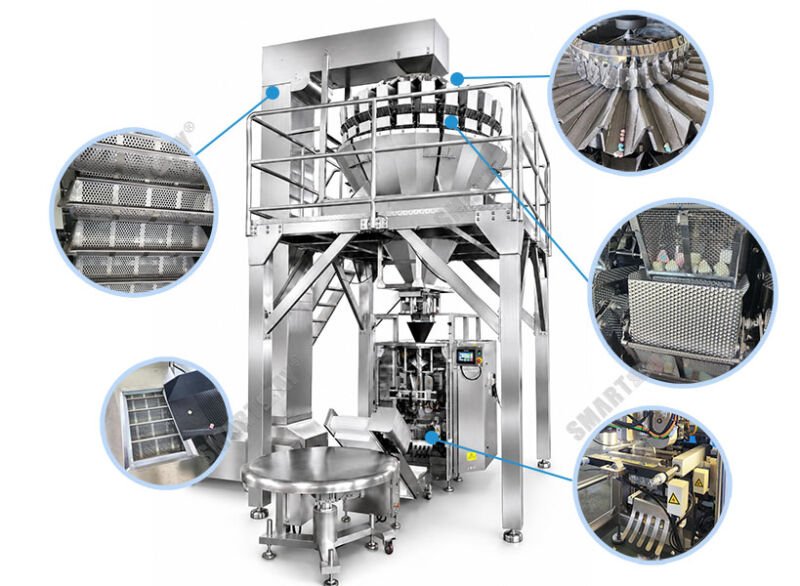
A lot of buyers focus on the bagging machine first. That is understandable because the bagger is easy to see.
But for gummies, the multihead weigher often decides whether the line runs smoothly or not.
The weigher controls product distribution, weighing accuracy, combination speed, and discharge timing. If the gummies do not feed well into the weigher, the whole line slows down. If the weigh buckets are not suitable for sticky products, you may see product buildup, poor discharge, and unstable accuracy.
For sticky gummies, the multihead weigher should be designed with anti-stick features. Depending on the gummy type, this may include dimple plates, suitable hopper angles, controlled vibration, optimized discharge chutes, and surfaces that reduce product sticking.
A good weigher setup should help you:
- Reduce product giveaway
- Improve weight consistency
- Keep gummies moving smoothly
- Prevent excessive clumping
- Match the speed of the bagging machine
- Reduce cleaning and downtime
This is where real packaging experience matters. Two gummies may look similar in a brochure, but run very differently on a machine. Sugar-coated gummies, oil-coated gummies, vitamin gummies, and soft jelly-style gummies may all need different feeding and weighing adjustments.
That is why Smart Weigh USA normally recommends reviewing the actual product condition before confirming the final machine configuration.
Feeding System Design Matters More Than Many Buyers Think
A gummy packaging line starts before the weigher. If the feeding system is not designed correctly, the weigher will never perform at its best.
For gummies, feeding equipment may include an incline conveyor, bucket elevator, product conveyor, vibratory feeder, or customized feeding solution depending on the product condition and plant layout.
The feeding system should move gummies steadily without crushing, sticking, or overloading the weigher. Too much product flow can flood the weigher. Too little flow can starve it. Both situations create speed and accuracy problems.
For sticky gummies, the feeding system may need food-grade contact surfaces, easy-clean design, controlled speed, and smooth transfer points. The goal is simple: keep the product moving at a stable rate so the weigher can do its job.
In a real production line, this is often where cheap machine setups fail. The bagger may look fine, but the product handling is not built for gummies. Then operators spend the shift tapping hoppers, clearing jams, and adjusting speed.
That is not automation. That is manual babysitting with a machine in the middle.
Match Machine Speed to Real Production Needs
When buyers ask for a gummy packaging machine, one of the first questions is usually: “How fast can it run?”
That is important, but the better question is: “What stable speed can it run with my actual gummies, bag size, target weight, film, and plant conditions?”
Machine speed depends on several factors:
- Target bag weight
- Gummy size and shape
- Product stickiness
- Bag width and length
- Film type
- Seal style
- Weigher head count
- Feeding stability
- Required inspection equipment
- Operator skill and changeover frequency
For example, a small pillow bag may run much faster than a large stand-up pouch. A dry sugar-coated gummy may flow better than a soft sticky gummy. A simple pillow bag may run faster than a zipper pouch.
For industrial gummy production, it is better to talk about stable production speed, not brochure speed. A machine that runs smoothly at 60 bags per minute all shift is more valuable than a machine advertised at 100 bags per minute but constantly stopping.
If you need faster output, Smart Weigh USA can review your target speed and recommend different solutions, such as a higher-speed VFFS line, multihead weigher upgrade, twin packaging setup, or fully integrated line design.
Pay Attention to Seal Quality
Seal quality is a big deal in gummy packaging.
If gummies drop too close to the sealing area, sugar or oil may contaminate the seal. If the film is not suitable, the seal may look weak or inconsistent. If the filling timing is not synchronized with the bagger, the product may get caught in the seal.
A good gummy packaging machine should control the filling process so the product lands cleanly inside the bag. The VFFS or pouch machine should also have stable sealing temperature, pressure, and dwell time.
For some gummy products, nitrogen flushing or modified atmosphere packaging may not be necessary. For others, especially products sensitive to moisture or shelf-life requirements, additional packaging functions may be considered.
The bottom line is simple: a good-looking bag means nothing if the seal fails.
Look for Food-Grade and Easy-Clean Design
Gummy packaging equipment should be built for food production environments.
That usually means stainless steel contact parts, hygienic design, smooth surfaces, accessible cleaning areas, and proper guarding. For gummies, easy cleaning is especially important because sugar, oil, and sticky residue can build up over time.
The machine should allow operators to clean key product-contact areas without wasting hours on disassembly. Fast cleaning is not just a sanitation issue. It also affects uptime, labor cost, and changeover speed.
If your factory runs multiple gummy flavors, colors, or formulas, cleaning and changeover become even more important. A machine that is hard to clean may become a bottleneck, even if it looks good on paper.
Do Not Ignore Checkweighing and Metal Detection
For serious production, a gummy packaging line should not stop at filling and sealing.
Inline inspection helps protect your brand and reduce costly problems down the road. A checkweigher verifies finished bag weight and rejects underweight or overweight packs. A metal detector helps catch metal contamination before products leave the line.
For gummy manufacturers selling to retailers, distributors, or private label customers, these systems are often expected. They also help reduce complaints, rejected shipments, and quality disputes.
A complete gummy packaging line may include:
- Product feeding
- Multihead weighing
- Bag forming or pouch filling
- Sealing
- Date coding
- Checkweighing
- Metal detection
- Labeling
- Cartoning
- Case packing
- Palletizing
This is the difference between buying a single machine and building a production line that is ready for growth.
Think About Changeover Before You Buy
Many gummy factories do not run only one product forever. They may pack different flavors, colors, shapes, weights, and bag sizes.
That means changeover matters.
Before choosing a gummy packaging machine, ask these questions:
- How many bag sizes will you run?
- How often will operators change SKUs?
- Will you run pillow bags and stand-up pouches?
- Do you need zipper pouches?
- How long does film changeover take?
- How easy is it to adjust the weigher recipe?
- Can operators save product parameters in the HMI?
- How fast can the line restart after cleaning?
A flexible packaging line may cost more upfront, but it can save a lot of time if your production schedule changes often.
For American manufacturers dealing with labor shortages and shorter production runs, changeover efficiency is not a small detail. It directly affects your daily output.
Watch Out for Hidden Costs
The cheapest gummy packaging machine is not always the lowest-cost solution.
Hidden costs usually show up later:
- Product giveaway from poor weighing accuracy
- Downtime from product sticking or jamming
- Labor cost from constant machine monitoring
- Poor seals and rejected bags
- Slow cleaning and changeover
- Lack of spare parts
- Weak after-sales support
- Difficulty integrating with existing equipment
- No layout planning for future expansion
A better way to evaluate equipment is total cost of ownership. How much product will you save? How much labor can you reduce? How much downtime can you avoid? How much faster can you fulfill orders?
That is the real ROI conversation.
What Information Should You Prepare Before Asking for a Quote?
To get a useful gummy packaging machine recommendation, prepare the basic production details first.
You do not need to have everything perfect, but the more information you provide, the better the solution will be.
Useful details include:
- Gummy type and shape
- Product photos or samples
- Whether the gummy is sticky, sugar-coated, waxed, sanded, or oily
- Target bag style
- Bag size
- Target weight per bag
- Required speed
- Film or pouch material
- Current packing method
- Factory layout
- Power requirements
- Need for checkweigher, metal detector, labeling, cartoning, or palletizing
- Future SKU expansion plans
For sticky or unusual gummies, sending product samples is highly recommended. Real testing can reveal issues that a spec sheet cannot.
Recommended Gummy Packaging Solutions
For most gummy manufacturers packing into bags, Smart Weigh USA usually recommends one of the following directions.
Multihead Weigher + VFFS Gummy Packaging Line
This setup is suitable for pillow bags and high-output gummy candy production. It is a strong choice when your main goal is stable speed, accurate weighing, and lower packaging material cost.
It can be configured with an anti-stick multihead weigher, VFFS bagger, date coder, checkweigher, metal detector, and finished bag conveyor.
This is often the most practical solution for factories producing retail pillow bags or snack-size gummy packs.
Multihead Weigher + Premade Pouch Packing Line
This setup is suitable for stand-up pouches, zipper pouches, and premium retail gummy packaging.
It is a good choice when shelf appearance and consumer convenience matter more than maximum speed. The line can include pouch opening, filling, sealing, coding, inspection, and discharge.
For functional gummies and private label products, this format is especially common because the finished package looks more premium.
Fully Integrated Gummy Packaging Line
For growing manufacturers, the real opportunity is not just packing gummies into bags. It is connecting the whole process.
A complete line can include feeding, weighing, filling, sealing, inspection, labeling, cartoning, case packing, and palletizing. This reduces manual handling, improves consistency, and gives the factory more room to scale.
Smart Weigh USA can support custom turnkey packaging solutions based on product condition, target speed, bag style, and factory layout.
Final Thoughts: Choose the Line, Not Just the Machine
Choosing a gummy packaging machine is not just a buying decision. It is a production decision.
The right line should handle your gummy’s real behavior, match your package format, hit your target speed, protect weighing accuracy, keep seals clean, and reduce labor pressure.
For pillow bags, a VFFS gummy packaging line is usually the workhorse. For stand-up and zipper pouches, a premade pouch packing line gives better retail presentation. For larger production plants, a turnkey line with inspection and end-of-line automation can make the biggest long-term difference.
The smartest move is to start with your product, your bag style, and your output target. From there, the machine configuration becomes much clearer.
If you are planning a gummy packaging project, Smart Weigh USA can help review your product, bag format, speed requirement, and plant layout to recommend a suitable packaging solution for your production line.
Send us your gummy samples, target bag size, and required output. We will help you build a practical line that runs smoothly today and can still support your growth down the road.
