 Skip to content
Delta Robot Case Packing: When Is a Complete End-of-Line System the Better Choice?
A fast packaging machine does not guarantee high production output. If operators cannot erect, load, seal, and palletize cases fast enough, the bottleneck simply moves downstream.
A Delta robot automates high-speed product picking and case loading. A complete end-of-line system goes further by integrating pack inspection, conveying, case erecting, robotic loading, case sealing, labeling, and palletizing under coordinated control. The right solution depends on where manual handling and production bottlenecks remain.
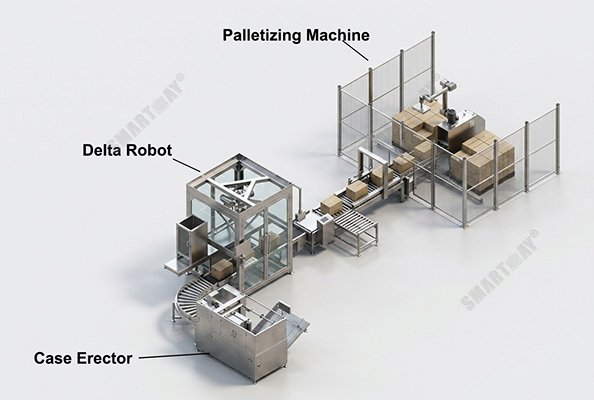
What Does a Delta Robot Actually Automate?
A Delta robot is designed for fast, repetitive pick-and-place operations. In a packaging line, finished bags, pouches, trays, or small cartons travel from the primary packaging machine onto an infeed conveyor. A vision system or tracking sensor identifies each pack’s position and orientation while the robot picks it without stopping the conveyor.
Depending on the case pattern, the robot may load one pack at a time, pick several packs together, or place a complete pre-collated row into the shipping case. The products can be laid flat, positioned vertically, arranged in alternating directions, or loaded in multiple layers.
When the output exceeds the practical capacity of one robot, a second or third Delta robot can be added. The control system distributes incoming packs among the robots so that the line continues running at the required speed.
However, a Delta robot normally does not perform every end-of-line task. It does not automatically solve:
- Empty case erecting and bottom sealing
- Case delivery to the loading station
- Pack inspection and rejection
- Closing and sealing filled cases
- Case labeling and coding
- Finished-case palletizing
- Accumulation during short downstream stops
- Speed coordination between separate machines
A Delta robot may be the heart of a high-speed case packing cell, but it is still only one part of complete end-of-line automation.
How Does a Complete End-of-Line Packaging System Work?
A well-designed system follows the actual movement of the product instead of treating each machine as an isolated piece of equipment.
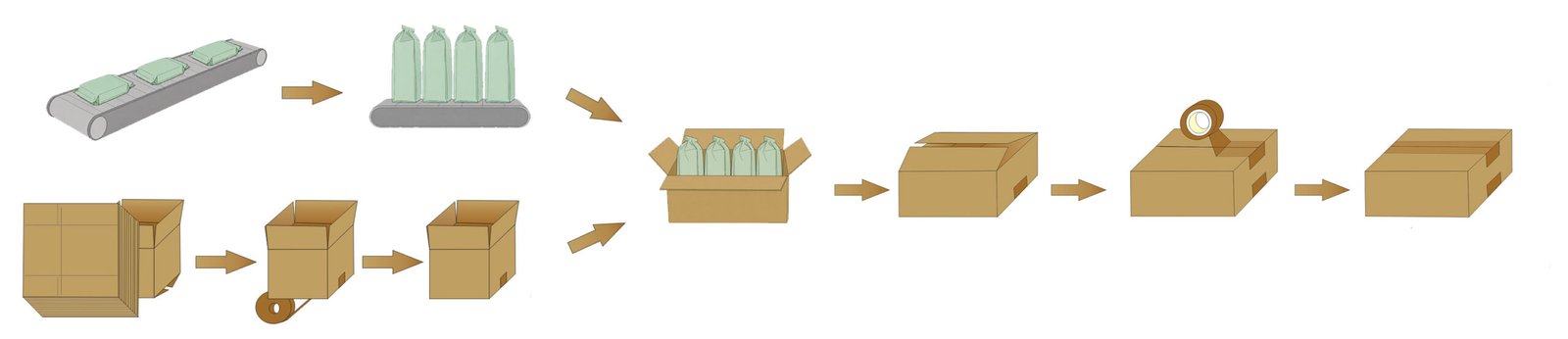
Pack Inspection and Infeed
Finished packages leaving a VFFS machine, premade pouch machine, tray sealer, or flow wrapper first enter the conveying and inspection section.
Depending on the application, this section can include checkweighing, metal detection, seal inspection, code verification, and automatic rejection. Removing an underweight, contaminated, or improperly sealed pack before case packing prevents operators from having to open finished cases later.
The conveyor system then separates, aligns, or groups the accepted packs for robotic picking. Stable product presentation is essential. Even an accurate robot cannot reliably pick bags that arrive overlapping, rotating, or piled against one another.
Automatic Case Erecting
A case erector removes a flat corrugated blank from the magazine, opens it, folds the bottom flaps, and seals the bottom with tape or hot-melt glue. The erected case is then conveyed to the robotic loading station.
The case erector must match both the case packing speed and the corrugated board being used. Poorly formed cases, inconsistent board quality, or slow empty-case transfer can limit the entire line even when the Delta robot has enough picking capacity.
Delta Robot Case Packing
Once an empty case reaches the correct position, the Delta robot loads the incoming packages according to the programmed pattern.
Several decisions affect this process:
- Random picking or pre-collated picking
- Single-pack or multiple-pack picking
- Horizontal or vertical bag placement
- Number of packs per row and layer
- Number of layers per case
- Single-, dual-, or multi-robot configuration
The robot, conveyor tracking, vision system, vacuum supply, and end-of-arm tooling must be designed together. Simply installing a fast robot above a conveyor does not guarantee stable case packing.
Case Sealing, Coding, and Inspection
After loading, the case moves to an automatic sealer. The machine folds the top flaps and applies tape or hot-melt glue.
Additional equipment can then print or apply shipping labels, barcodes, SKU information, and batch data. Case checkweighing can confirm that the correct number of packs has been loaded. This is especially useful when a missing bag would otherwise be discovered by the customer.
Robotic Palletizing
Sealed cases travel to the palletizing station, where a robotic palletizer stacks them according to a programmed pattern. The system can also integrate a pallet dispenser, slip-sheet placement, finished-pallet conveyor, and stretch wrapper.
The result is continuous product flow from the primary packaging machine to a stable pallet ready for warehousing or shipment.
Why Is Robotic Case Packing More Difficult for Flexible Bags?
Flexible bags are harder to automate than rigid cartons because their shape can change from one pack to the next.
A pillow bag may look consistent when empty, but after filling, its thickness depends on product distribution, trapped air, and sealing conditions. Nuts, candy, frozen vegetables, and snack products can shift inside the bag while it travels along the conveyor, changing the center of gravity.
Nitrogen-filled snack bags create another challenge. They must be handled without excessive compression, while the case pattern must fit enough bags without crushing the product or stressing the seals. Gusset bags and premade pouches may also need to stand vertically inside the case, requiring more control over bag orientation.
The bag surface affects gripping reliability as well. Wrinkled film, oily residue, product dust, condensation, and uneven package surfaces can all reduce vacuum stability. The seal area may not provide a safe gripping point, and an unsuitable suction cup can deform the package or lose vacuum during acceleration.
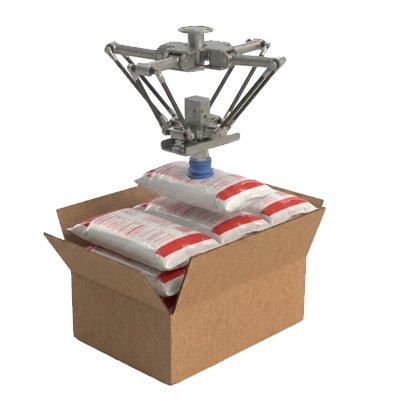 Pillow bags in case | 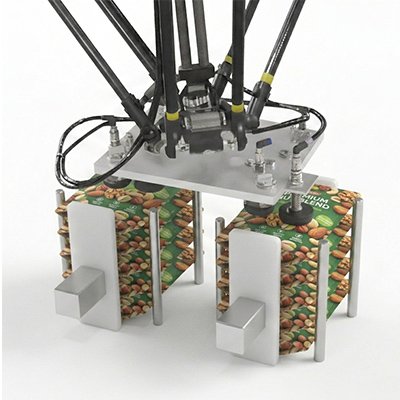 Premade pouches in case |
Reliable Picking Starts Before the Robot
Robot accuracy is only one part of pick reliability. Missed picks are often caused by:
- Inconsistent spacing between bags
- Bags overlapping before the picking zone
- Incorrect or changing discharge orientation
- Poorly selected suction cups
- Unstable vacuum pressure
- Wrinkled packaging film
- An incorrect pick point
- Insufficient conveyor tracking
- Product accumulation during case change
For this reason, Smart Weigh designs the infeed conveyor, bag separation, product tracking, vision recognition, vacuum tooling, and case pattern as one system.
In some applications, the packs should be individually tracked and picked as they arrive. In others, it is more reliable to turn, stand, or collate the bags into groups before the robot picks them. The best method depends on the bag style, speed, product behavior, and required arrangement inside the case.
Which Level of End-of-Line Automation Does Your Factory Need?
Not every factory needs to automate everything at once. The right scope depends on the existing equipment and the location of the real bottleneck.
| Automation Level | Typical Configuration | Best Suited For | Remaining Manual Work |
|---|---|---|---|
| Standalone Delta Robot | Product conveyor, tracking or vision, and robotic loading | Lines with reliable case supply and downstream equipment | Case erecting, sealing, or palletizing may remain manual |
| Integrated Case Packing Cell | Case erector, Delta robot, and case sealer | Lines where manual case preparation and loading limit output | Palletizing may still require operators |
| Complete EOL System | Inspection, case erecting, robotic loading, sealing, labeling, and palletizing | High-output lines requiring minimal repetitive handling | Mainly replenishment, supervision, changeover, and exception handling |
A standalone Delta robot is suitable when the surrounding equipment is already in place and manual case loading is the only serious constraint.
An integrated cell makes more sense when operators are opening cases, loading packs, and sealing cases at separate workstations. Automating these connected tasks reduces interruptions caused by late empty-case supply or inconsistent sealing.
A complete system is usually justified when multiple manual processes limit a high-speed packaging line. If bags accumulate at the discharge, night-shift output is inconsistent, or additional production would require a large increase in labor, automating only the robot loading station may leave the larger problem unresolved.
The goal is not to purchase the highest possible level of automation. It is to remove the current bottleneck while leaving enough capacity for future production.
What Determines the Output of the Complete System?
Delta robot speed is important, but the robot’s maximum cycle rate does not represent the sustainable output of the complete line.
The first design input should be the primary packaging machine’s normal continuous output—not a short-term maximum shown in a brochure. The end-of-line equipment must handle normal fluctuations without causing bags to accumulate.
Packs per case also matter. A line producing 100 bags per minute and loading ten bags per case requires ten completed cases per minute. Loading 20 bags per case reduces the number of case changes, but it may require a more complicated multi-layer arrangement.
The picking strategy can significantly affect capacity. Picking two or three bags at once can reduce robot cycles, but only if the packages can be grouped consistently and the tooling can hold them securely.
Case change time is another common limitation. After a case is full, it must leave the loading position and an empty case must take its place. If incoming bags cannot be buffered during this period, the robot or packaging machine may have to wait.
Short-term accumulation provides breathing room when operators replace tape, replenish labels, or clear a minor case fault. However, accumulation must be carefully designed for flexible packaging because too much back pressure can cause bags to overlap, rotate, or become damaged.
Finally, the case sealer, labeling equipment, conveyor, and palletizer must all have enough capacity. The real target is not the fastest robot cycle; it is stable, saleable output from the packaging machine to the finished pallet.
Can End-of-Line Automation Be Added to an Existing Packaging Line?
Yes. A factory can add a Delta robot cell or complete EOL system after an existing VFFS machine, premade pouch machine, tray sealer, or flow wrapper. However, selecting the system based only on bags per minute is risky.
Before designing the upgrade, the supplier should confirm:
- Product characteristics and pack weight
- Bag style, material, and filled dimensions
- Normal and maximum line output
- Bag discharge direction and conveyor height
- Number of bags per case
- Required bag orientation and case pattern
- Case dimensions and corrugated quality
- Available floor space and access points
- Existing PLC signals and communication requirements
- Required pallet pattern
- Future SKUs and capacity plans
Actual filled samples are especially valuable. Two bags with the same dimensions may behave differently if one contains lightweight chips and the other contains dense nuts or frozen product.
Smart Weigh can test the proposed system using the customer’s finished packs, shipping cases, and required case pattern. Factory acceptance testing should verify continuous speed, pick success, bag orientation, loading pattern, case transfer, fault recovery, and communication between machines.
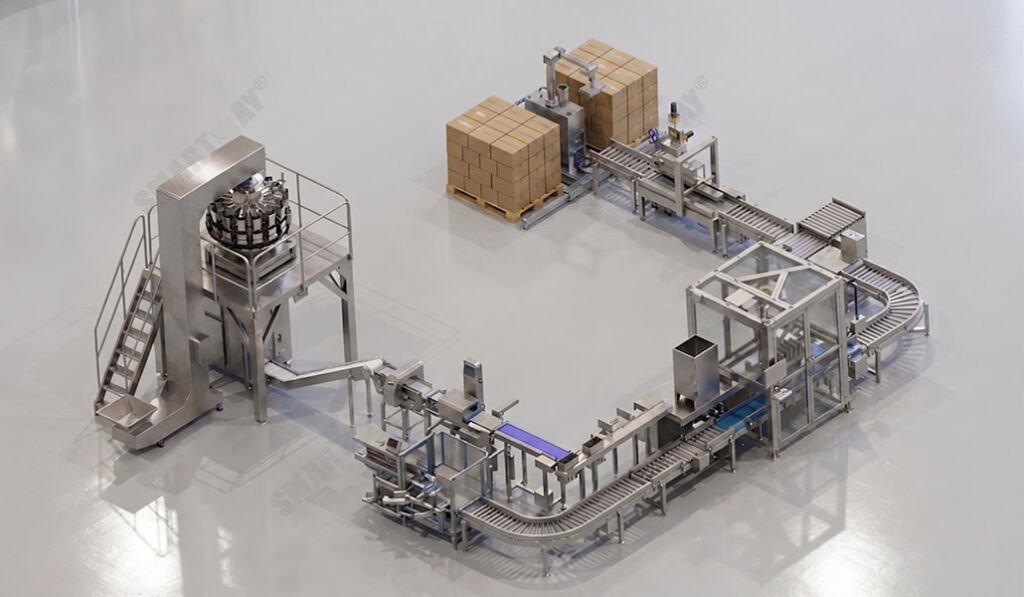
Existing VFFS packaging line upgraded with automatic case erecting, Delta robot loading, and case sealing
Automate the Bottleneck, Then Design for the Complete Flow
A Delta robot can remove repetitive manual picking and deliver consistent case patterns. But if operators still struggle to supply empty cases, seal filled cases, or clear finished cartons, the bottleneck has only moved to another station.
Smart Weigh can provide a standalone Delta robot case packing unit, an integrated case packing cell, or a complete end-of-line system covering automatic case erecting, robotic loading, case sealing, labeling, and palletizing.
Because we also design weighing and primary packaging systems, the EOL solution can be matched to the complete product flow instead of being treated as a disconnected downstream project.
Send us your filled bag samples, case dimensions, required output, and case packing pattern. We can evaluate which level of automation fits your existing line and future production plans.
FAQs
What Packages Can a Delta Robot Load Into Cases?
Delta robots can handle pillow bags, gusset bags, premade pouches, trays, flow-wrapped products, and small cartons. The tooling and infeed system must be customized for the package surface, weight, shape, and required orientation.
Can One Delta Robot Handle Different Bag and Case Sizes?
Yes, within a confirmed size range. Product recipes can change robot motions and case patterns, while guide rails, suction cups, or complete tooling may require adjustment or replacement.
How Many Delta Robots Does a Packaging Line Need?
It depends on continuous pack output, robot travel distance, packs per pick, case pattern, case change time, and planned future capacity. Testing the actual package is the most reliable way to confirm the configuration.
Can the System Connect to an Existing VFFS Machine?
Yes. The design must account for the VFFS discharge direction, conveyor height, bag spacing, speed signals, available floor space, and existing control system.
Does a Complete EOL System Still Require Operators?
Yes, but their role changes. Operators replenish cases, tape, labels, and pallets while supervising changeovers, cleaning, and exception handling. Repetitive case erecting, loading, sealing, and palletizing can be largely automated.
