 Skip to content
Cannabis Flower Packaging: Premade Pouches vs Jars
Premade pouches and jars can both work well for dried cannabis flower, but they solve different packaging priorities.
Premade pouches generally reduce packaging, storage, and transportation costs. They also provide more printable space and are easier to manage when a brand has many strains or package designs. Jars provide stronger protection for large buds and create a more rigid, premium presentation, but they require more packaging components and downstream equipment.
The right choice depends on more than appearance. Bud size, product value, target weight, closure design, required output, warehouse space, and automation costs all affect the decision.
This article focuses on dried cannabis and CBD flower, including whole buds, small buds, and shake. Other cannabis products such as oils, concentrates, gummies, powders, and pre-rolls require different filling systems.
Where Premade Pouches and Jars Perform Differently
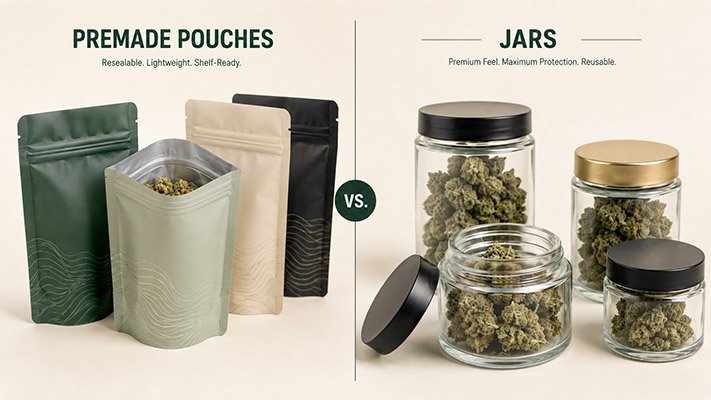
Cannabis flower is lightweight, irregular, and sensitive to compression. The package must protect the product while remaining practical to fill, close, inspect, ship, and display.
Premade pouches are available as flat pouches, stand-up pouches, Doypacks, resealable zipper pouches, and specialized child-resistant formats. Their main advantage is efficiency throughout the supply chain.
Empty pouches are light and compact. A large quantity can be stored in a relatively small warehouse area, and freight costs are normally lower than for rigid containers. Printed pouches also provide a large surface for branding, strain information, warnings, and product details without requiring a separate wraparound label.
For producers running many SKUs, printed pouches can make package changes easier. The packaging machine may only require gripper and recipe adjustments when the pouch dimensions remain within the machine’s working range.
However, flexible packaging provides less protection against crushing. Large or loosely structured buds can be compressed during case packing, transportation, or retail handling. A narrow pouch opening can also restrict the entry of larger buds, causing bridging above the pouch or flower buildup around the zipper.
The zipper and heat-seal areas are particularly important. Loose flower or shake entering these areas can prevent complete closure or produce an unattractive seal. Child-resistant zippers may require more force and a customized opening mechanism, which can reduce the reliable operating speed of an automatic pouch machine.
Jars solve many of these physical-protection problems. Glass, PET, HDPE, and other rigid containers help protect large buds from external pressure and maintain a consistent package shape. Clear jars may also allow customers to see the flower where local rules permit transparent packaging.
Rigid packaging can support premium positioning, but it creates additional costs. Jars and closures take up more storage space, increase finished-case weight, and normally cost more than flexible pouches. Glass also introduces breakage risks during container feeding, production, and distribution.
A jar is not a single packaging component. The container body, cap, liner, induction seal, label, and tamper-evident feature must work together. Changes in jar diameter, thread design, cap dimensions, or liner material can affect the filling and closing process.
For this reason, neither format should be selected from a catalog alone. Production-grade pouches or complete jar-and-cap sets should be tested before the equipment design is approved.
Premade Pouches vs Jars: Cost, Protection, and Shelf Performance
The following comparison shows the practical differences most likely to affect a packaging project.
| Comparison Factor | Premade Pouches | Jars |
|---|---|---|
| Bud protection | Moderate; can be compressed | Strong protection against crushing |
| Package cost | Generally lower | Generally higher |
| Empty-package freight | Low | Higher, especially for glass |
| Warehouse space | Compact before filling | Requires substantially more space |
| Branding | Large printable surface | Usually depends on applied labels |
| Product visibility | Usually limited | Possible with transparent containers |
| Child-resistant feature | Specialized zipper or pouch closure | Child-resistant cap or lid |
| Packaging process | Pick up, open, fill, and heat seal | Feed, fill, cap, seal, and label |
| Physical package damage | Pouch cannot shatter | Glass may chip or break |
| Case packing density | More units per case | Fewer units and heavier cases |
| Best product fit | Small buds, shake, value and mainstream products | Large buds and premium flower |
The lowest unit price does not always produce the lowest packaging cost. A more useful comparison includes:
- Pouch or jar cost
- Cap, liner, label, and seal cost
- Freight for empty packaging
- Warehouse space
- Labor per finished package
- Changeover time
- Secondary packaging
- Finished-case weight
- Damaged flower or broken containers
- Rejects caused by opening, sealing, or capping failures
Pouches normally perform well when material and logistics costs are the main concern. Their low weight can also increase the number of finished units packed into each shipping case.
Jars may justify their higher cost when protecting the appearance of premium whole flower supports a higher selling price. The added cost is harder to justify for shake, small buds, or price-sensitive product lines that do not gain much value from a rigid package.
Shelf performance should be evaluated separately from physical protection. A jar does not automatically provide a longer shelf life, and a pouch does not automatically provide a weaker barrier.
Actual performance depends on the pouch-film structure, jar material, closure, seal integrity, light exposure, oxygen transmission, moisture control, and headspace. A properly specified high-barrier pouch may perform better than a poorly closed jar. Likewise, a quality jar with a validated cap and seal may outperform a low-barrier pouch.
Nitrogen flushing can be incorporated into some pouch and jar lines, but it must be evaluated against the required cycle time. More flushing time may improve gas displacement while reducing output. Package integrity and shelf-life testing remain more meaningful than assuming a particular material will protect every flower product in the same way.
Neither pouches nor jars are automatically compliant. Child-resistant performance, tamper evidence, labeling, coding, and package visibility requirements vary by market. The complete package—not only the zipper or cap—should be verified for the jurisdiction where it will be sold.
How the Package Changes the Automatic Packaging Line
Both formats can use a customized multihead weigher to portion cannabis flower, but almost everything after the weigher is different.
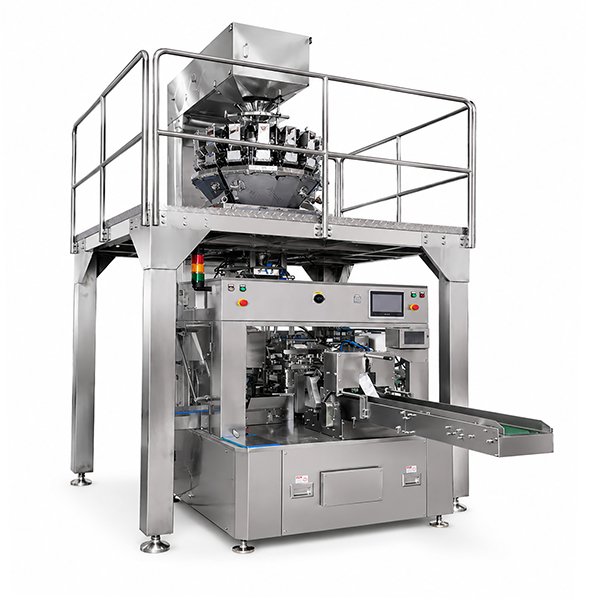
cannabis flower pouch packing machine
A typical premade pouch line includes:
- Controlled bulk product feeding
- Low-weight multihead combination weighing
- Automatic pouch pickup
- Pouch and zipper opening
- Flower filling
- Optional nitrogen flushing
- Top sealing
- Date, batch, or traceability coding
- Checkweighing and automatic rejection
The pouch machine must reliably separate and open each pouch. It also needs enough filling clearance for the largest buds and enough settling time to keep flower away from the zipper and final seal.
Important pouch-line features include adjustable grippers, pouch-opening detection, no-pouch/no-fill control, product-settling assistance, and accessible sealing areas. For child-resistant pouches, the supplier should test the actual closure rather than assuming that a standard zipper-opening device will work.
A typical jar line includes:
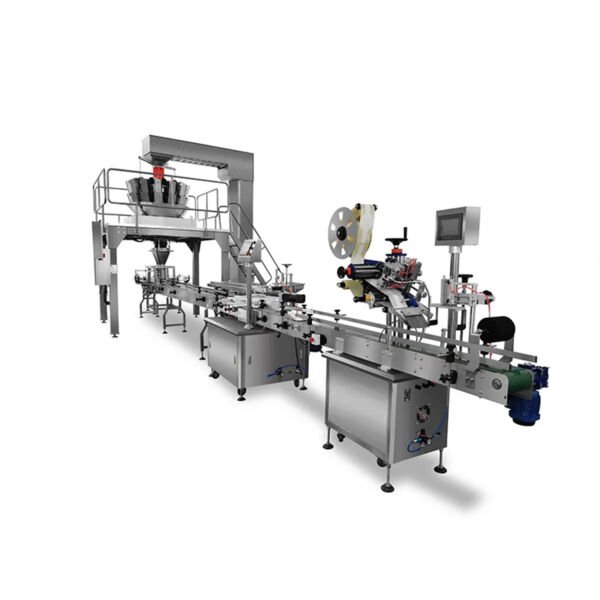
cannabis flower jar packing machine
- Empty-jar feeding or unscrambling
- Jar positioning beneath the filling station
- Low-weight multihead weighing
- Jar filling
- Cap feeding and placement
- Automatic capping
- Optional induction sealing
- Labeling and coding
- Checkweighing and rejection
- Case packing
Jar lines contain more independent handling steps. The conveyor must keep lightweight empty containers stable, the filling chute must fit the jar opening, and the capper must apply repeatable torque without damaging the closure.
Label application also becomes part of the line design. Round jars may rotate during labeling, while short or lightweight containers can become unstable if conveyor speed and guide-rail settings are not properly matched.
Jar tare weight deserves attention when a checkweigher is used to verify finished packages. If empty-container weight varies significantly, finished gross weight may not provide an exact measurement of the flower inside every jar. The supplier should explain how tare variation will be managed during inspection.
For both formats, the multihead weigher must be designed around low target weights and irregular flower sizes. Common retail weights such as 1 g, 3.5 g, 7 g, 14 g, and 28 g do not produce the same speed or accuracy.
At 1 g or 3.5 g, one bud can represent a large percentage of the target weight. Controlled feeding, suitable hopper capacity, load-cell resolution, and combination software become more important than the maximum number of machine cycles.
The advertised speed of an individual machine is not the finished-line output. A weigher may prepare portions faster than a pouch can open, or a jar filler may wait for the capping station. Buyers should compare accepted finished packages per minute after rejects and short stops—not the maximum speed of the fastest component.
Which Format Fits Your Product and Operation?
Premade pouches are usually the stronger option when:
- Packaging and transportation costs are closely controlled.
- Warehouse space is limited.
- The business manages many strains, graphics, or seasonal designs.
- A large printable branding area is important.
- The product consists mainly of small or medium buds.
- The operation needs an integrated filling and sealing process with fewer downstream machines.
- The finished product will not experience unacceptable compression during distribution.
Jars are usually a better fit when:
- Protecting the shape of large or premium buds is the main priority.
- Rigid packaging supports the brand’s price position.
- Product visibility is valuable and permitted in the target market.
- The operation can accept higher container, closure, storage, and freight costs.
- There is enough floor space for jar feeding, capping, sealing, and labeling equipment.
- The distribution process can control glass breakage or container damage.
Some producers benefit from using both formats. Premium whole flower may be packed in jars, while small buds, shake, or value-oriented products go into pouches. Different retail markets may also require different presentations.
However, a dual-format strategy does not mean one packaging machine can change directly from pouches to jars. The multihead weigher may be shared or designed to feed alternative discharge points, but pouch handling and jar handling require different downstream equipment.
Before investing in two formats, compare the cost of separate lines with the downtime and operational complexity of sharing one weighing system. If pouch and jar orders frequently run at the same time, independent lines may provide better production flexibility.
Test the Complete Package Before Ordering Equipment
Equipment testing should use the actual flower and production-grade packaging whenever legally and practically possible. If the flower cannot be shipped to the equipment supplier, a substitute product should match its approximate size, density, fragility, and feeding behavior.
A useful test should cover:
- Minimum and maximum bud sizes
- Every important target weight
- Average and maximum weight deviation
- Accepted packages per minute
- Flower breakage and shake generation
- Product remaining in feeders, hoppers, or chutes
- Pouch pickup and opening success
- Flower entering the zipper or sealing area
- Jar feeding and positioning reliability
- Seal integrity or capping consistency
- Changeover requirements
- Cleaning time
- Complete-line rejection rate
Run enough consecutive packages to expose intermittent problems. A short demonstration showing several successful fills cannot prove stable production. The test should record underweights, overweights, failed pouch openings, poor seals, cap errors, rejects, and unplanned stops.
The package should also be tested after filling. Evaluate compression, closure integrity, leakage, distribution damage, and shelf performance under the conditions the finished product will actually encounter.
Smart Weigh designs cannabis flower packaging systems around the complete production process, including controlled feeding, low-weight combination weighing, premade pouch filling and sealing, jar filling and capping, checkweighing, coding, labeling, and downstream automation.
Send us your flower specifications, target weights, required output, and production-grade pouch or jar samples. Our engineering team can test the product and recommend a packaging-line configuration based on measurable results.
